
Meeting a windigo
In August 2023, I met a windigo.
I had been travelling across Northern Ontario, getting to know First Nations communities, visiting the sites of abandoned Indian Residential Schools, trying to come to terms with the genocide Canada had committed. A few months later, I would launch the Remembering Project with the ideas that came from these relationships and these explorations.
The windigo approached me at a pow wow, where I was listening to a survivor give testimony to the abuse he had suffered at St. Anne’s Residential School in Port Albany.. They were curious about why I was so far from my home. We had a long conversation, and they shared some of their culture with me.
The ceremony was deeply moving. The journey there drew me deep into the land. First by plane to Thunder Bay, then by rental car for four hours through some of the most spectacular scenery to get there.
By the time I had reached Biigtigong Nishnaabeg First Nation, the sun was setting on the snow-dusted pines in the early winter of October. I found myself on a rocky outcropping overlooking a black lake, framed by a line of white forest and a dark purple line that was Lake Superior, and the starry sky above. An Ontario Garden of Eden.
The next day the windigo welcomed me to their reserve. New to the culture, they opened doors for me, teaching me to make my own deerhide drum, from scratch, so I could participate in ceremony. We even saw a bear walk by their home. It occurred to me this would only happen because I was so deep in the land – and into connection with those who have loved the land forever.
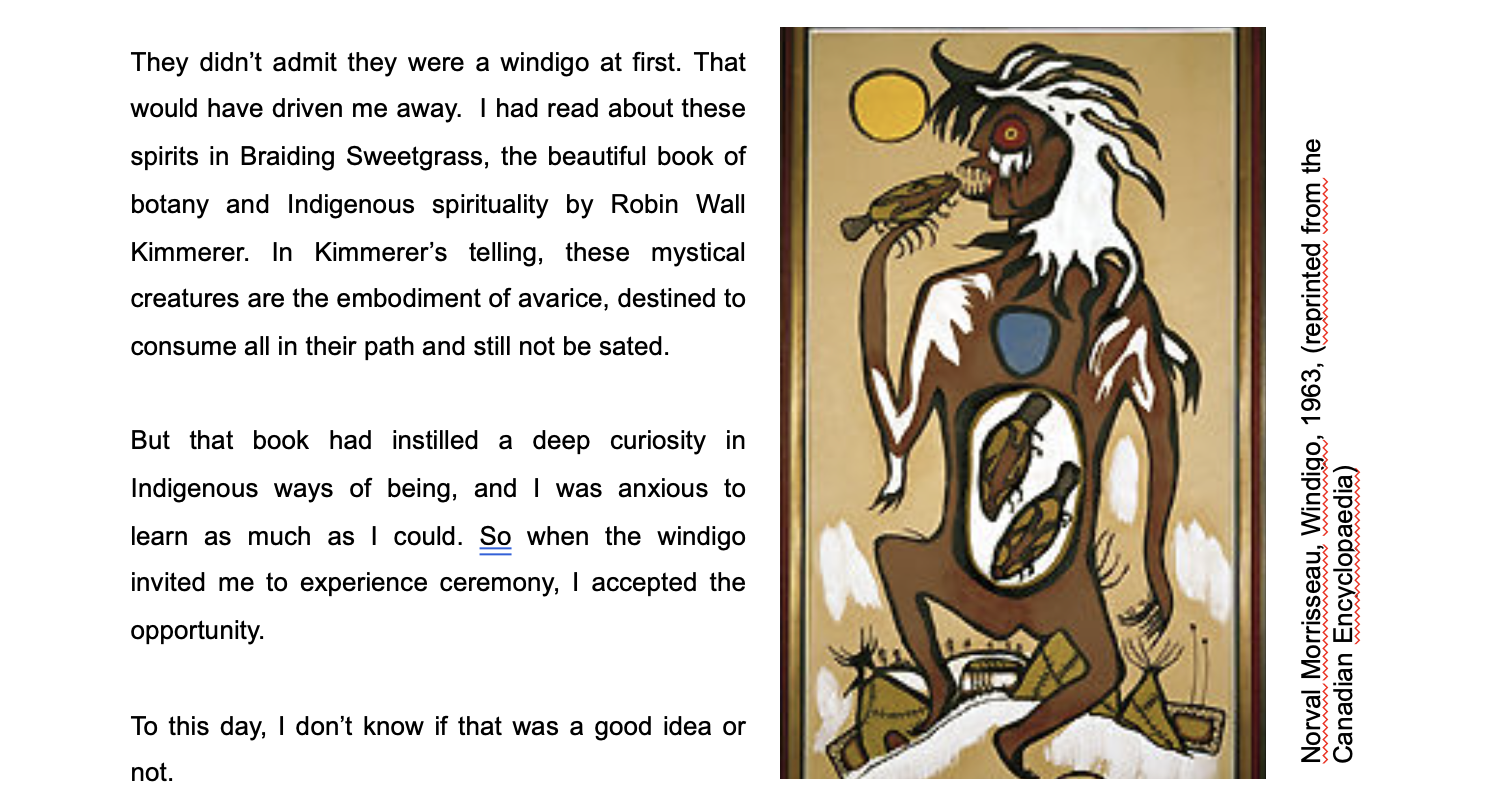
This was when they revealed they were a windigo. I was taken aback – in a Christian context, would that a bit like admitting you are a demon? A mythical figure associated with bad intentions and bad actions? Not at all, the windigo explained – Anishinaabe spirituality is not dualistic like Christianity. Life requires balance, and balance requires both ends of any continuum to be present in equal measure.
I soon saw this balance in practice. The windigo was one of four spiritual leads in the ceremony – their contrary energy plays an essential part in establishing balance. If you have positive, you have to have negative. White must be balanced with black. That’s how you achieve unity. As the songs filled our ears, as the drums led our feet, that sense of unity came to life. And I was part of it.
I don’t know if I have ever felt belonging in this way before. Here I was, a non-Indigenous Canadian from Toronto, a descendant of Anglican ministers who had set up residential schools – not just an outsider to this community but a carrier of responsibility for the harm they had suffered.
And yet the people of Biigtigong Nishnaabeg welcomed me.
The lessons in balance, and in relationship, followed a lesson I had already learned about reciprocity. When you receive a gift, you must offer one of your own. And the experience of being welcomed was certainly a gift.
The opportunity seemed to present itself months later. The windigo sought spiritual training by someone in my part of Ontario. I offered to pay for the transportation to come down, participate for a week, then return home.
From here on in, the lessons got much more painful.
The windigo accepted the gift - but came to my home instead. And tried to stay.
They introduced me to Anishinaabe circles in Toronto, but then told me the others were suspicious of me, and that without the windigo there, no one would trust me.
Perhaps your gifts need another outlet, I suggested. I helped them set up their own business and found their first client. But when I offered to help fill out a grant application to fund their business, they accused me of trying to seek money for my own project.
One day the windigo gave up and decided to return home. They drove out of town, but their truck broke down just as they were leaving town. I bought them a plane ticket, and they refused to take it, blaming me for the broken truck.
In time, I realize I was in a twisted kind of prism. Anything I said was interpreted as the opposite. When I said up, they heard down. When I said right, they heard left. Anything tried to do to help was interpreted as hurtful.
I made one final gift, a belt to reciprocate a belt the windigo had made. Let us go our own separate ways, but honour the lessons we had learned from one another. The final straw came when the windigo filmed the exchange and posted it on Instagram. True to form, they interpreted the gift as its opposite. The belt was not a parting gift, they said, it was a bond of marriage.
This was one inversion too much for me. Sacred had become profane. I was repulsed.
I hoped I could just walk away from it all. I had sought to build new relationships across the chasm between Indigenous and non-Indigenous societies. But I would lose just as many relationships as I had created.
Furious at the loss of contact, the windigo sought out my ex-wife and got the names of colleagues, friends and others dear to me. They wrote to as many as possible, making outlandish claims of marriage and betrayal.
The Remembering Project carries on, confronting the sins of our past, building new relationships where we can. I can see it in the trust our survivor partners place in us.
But we are now haunted by a windigo, who seeks to sever relationships just as we build them.
It is as if the same balance we celebrated in ceremony in Biigtigong Nishnaabeg is now a balance we cannot escape – the balance of creation and destruction proceeding in equal measure.
All we can do, it seems, is commit to keep building relationships in spite of the ups and downs. And to keep learning.
