
Where Flowers Bloom, So Does Hope
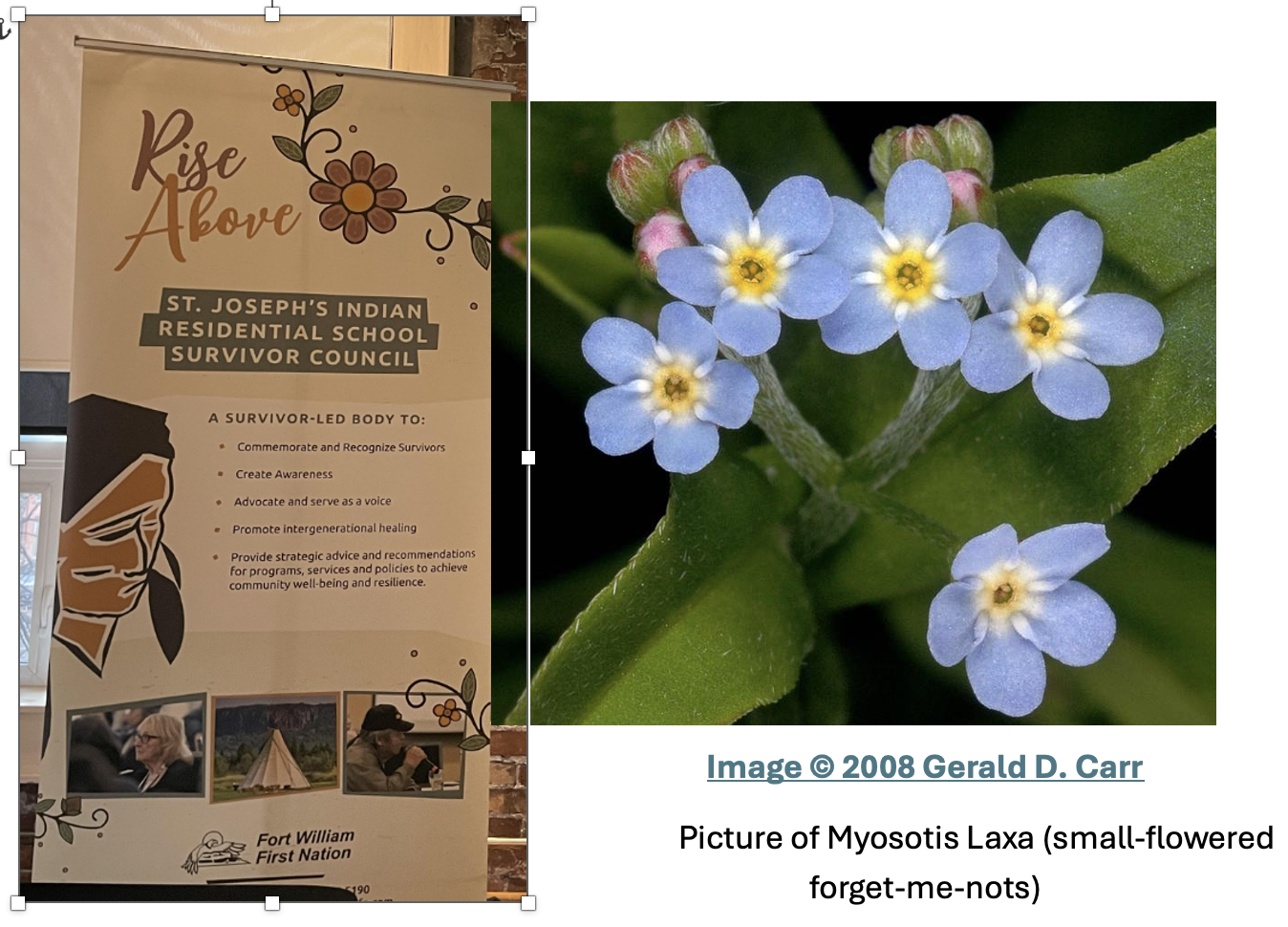
Former First Lady Bird Johnson, the wife of former U.S. President Lyndon Baines Johnson, said, “Where flowers bloom, so does hope.”
Her quote resonated with me for a couple of reasons. First, it reminded me of something I’d recently learned – that Myosotis Laxa is the scientific name for the small-flowered forget-me-not, a pretty little blue flower native to both Canada and the United States. Second, it served as a point of encouragement to me, because hope and renewal are, slowly but surely, taking root in the hearts of some of our country’s residential school survivor communities.
I caught a glimpse of this revival of hope during my recent trip to Thunder Bay with Ben Rowswell and fellow volunteer Ashvin Sharma. A couple of us went up from Toronto to accompany Ben as he presented some of our more archival research projects to representatives of Fort William First Nation, where this school was based. All credit for this task goes to Remembering Project volunteers Stephanie, Coridelia, Jeanette, Rose, Angela, Joan and the remarkable students of Professor Amelia Katanski’s classes at Kalamazoo College in Michigan, USA, who engaged in and completed this work.
As he presented, my eyes travelled around the room, briefly settling on a beautifully decorated banner with the words “Rise Above” near some gorgeous flowers located at its top left corner. In that moment, various emotions swirled around in my psyche. First, sorrow for all that Indigenous communities across our country, including Fort William First Nation, had suffered. Second, gratitude for the survivors of St. Joseph’s IRS for trusting our volunteers to engage in this work. Third, awe, to be a small part of helping to right historical wrongs as a volunteer. Last, but not least, hope that survivors will find encouragement in knowing that there are indeed Canadians who care about them, their stories, and their communities, and that they have our support in helping them rise above their deep trauma and pain.
But perhaps residential school survivors aren’t the only ones rising above their pain. As one who identifies with the Christian faith, it hurts me deeply to know there have been those who have named the name of Christ while authorizing acts of great cruelty in a war in the Middle East.
Lady Bird’s husband had waged a war that killed hundreds of thousands in Vietnam; perhaps it was the weight of that knowledge that drove her need to find hope. But at least President Johnson didn’t justify the killing by associating it with a religion of peace.
Perhaps this is part of what gives me a reason to continue as a volunteer with the Remembering Project. Then, as now, terrible harms are being done in the name of something I am part of. Something I associate with love is being used for violence.
Volunteering with the Remembering Project is one way to take back what Canada means from those who invoked our nation while harming children.
As a Christian, it is a way for me to not only help bring about justice for those in need but also to walk by faith, serve with love, and walk the long road of truth and reconciliation. That, and not war, is what it is all about.
As the printed copy of the Student Register passed from Ben’s hands to those of the community, I gazed again at the words, “Rise Above,” on the banner. In that sober moment, I realized that the community finally had, in their possession, pages of previously obscured, hidden, and forgotten Canadian history – that is, pages filled with dozens upon dozens of rows of personal information about the children who attended St. Joseph’s IRS.
It’s never easy dealing with grief and loss, and I am often reminded of these things as I help complete our collective tasks. But all our work is freely done as a labour of love for Canada’s residential school survivors, and in the full recognition of the harms done in our name. By volunteering, we collectively plant forget-me-nots in another kind of garden – a garden of hope in the rocky soil of North American history.